
DISCOVERING BLOOMSBURY
How Metadata Builds Success
Diana the Huntress, the goddess that represents Bloomsbury Publishing plc, first entered our literary consciousness in 1986. Bloomsbury’s founder, Nigel Newton, had started an adventure that has become the stuff of legend.
 Less than a week after its launch, Bloomsbury had a stand at the Frankfurt Book Fair. It offered visitors quarter bottles of Bollinger but not yet any books. Books were coming, and they would be remarkable. This confident and flamboyant mise en scène set the tone for its future: bold, stylish, with an emphasis on quality.
At the Frankfurt Book Fair nearly forty years later, I was representing my own company, BDS. I had a meeting arranged with Bloomsbury Head of A&P Metadata and Discovery, Fiona Green. Our topic of discussion, of course, was metadata or, more precisely, detail around integrating Bloomsbury’s academic publishing information into our new resource for academic libraries, UniCat.
BDS and Bloomsbury have worked together throughout BDS’s thirty years of trading. Both companies have grown into success stories and, I like to think, both companies have shared values and have changed their respective industries for the better. It wasn’t long into the meeting that Fiona and I hatched the idea of a behind the scenes article.
I would visit the Bloomsbury offices in Bedford Square, London to discover how Bloomsbury “does” metadata for its academic publications. We both agreed to find a date and we looked forward to building even closer ties between our two companies.
Rapid Success and Growth

Bloomsbury, the London district, is quintessentially English; it suggests the Bloomsbury Group, that Edwardian literary and arts avant-garde. It boasts leafy squares, antiquarian bookshops and the British Museum. One such leafy square, Bedford Square, could not be better placed as the home of Bloomsbury Publishing. It is a sign of the company’s marketing flair that it moved from operating above a Chinese restaurant in Putney in 1986 to its current offices in 2011, “in buildings which reflect the Bloomsbury brand”.
For many readers, Bloomsbury is famous for its award-winning fiction publications and the Harry Potter series of novels. Its first Booker prize came in 1992, just six years after the company launched. Harry Potter, as we all know, took the world by storm.
Voted Publisher of the Year at the British Book Awards 2025, growth has been in many directions. Nearly forty years of success has allowed Bloomsbury to acquire many smaller and some not-so-small imprints, including the Arden Shakespeare and Methuen Drama. It has offices in the US, India, Australia and will be opening an office in Singapore later this year.
Nine months after our meeting at Frankfurt, I approached the Bloomsbury offices to find out about Bloomsbury’s metadata. With the purchase of Rowman & Littlefield, a leading US-based publisher with a backlist of over 45,000 titles, Bloomsbury grew its academic offering significantly.
For BDS, it is essential that the metadata on those 45,000 titles and other Bloomsbury academic titles, including open access books, seamlessly integrates into its UniCat service to academic libraries. As such, my visit is part of BDS’s publisher liaison activity but visiting Bloomsbury is always an adventure of discovery.
Relaxed Elegance
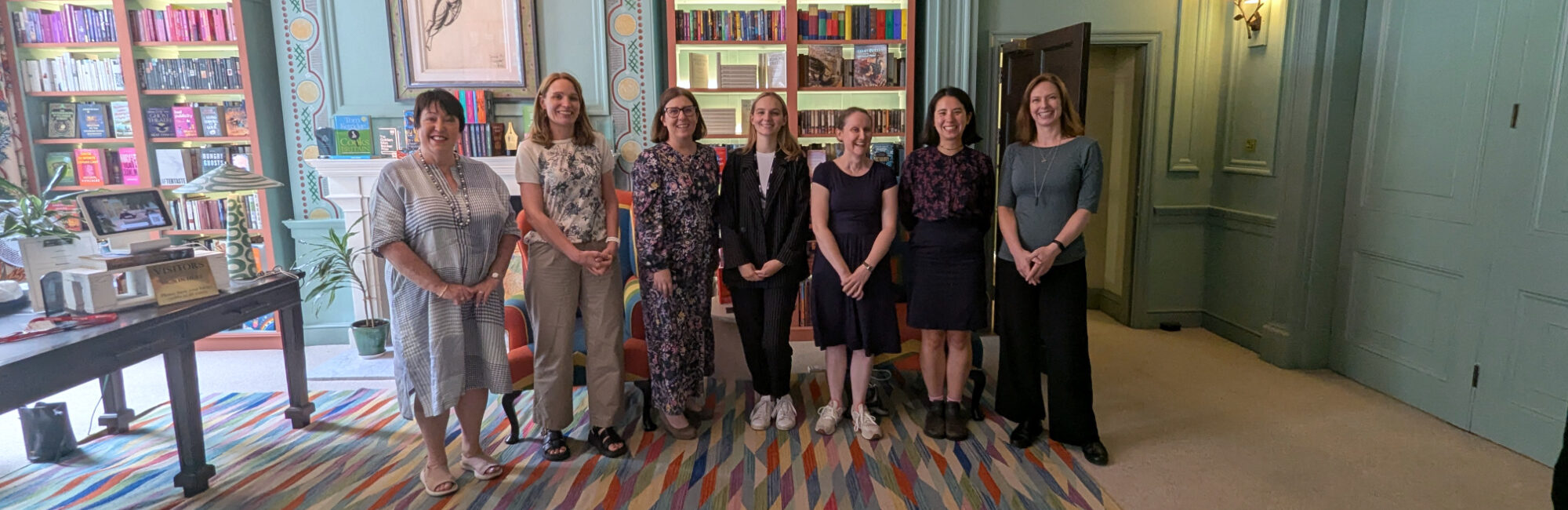
I am greeted by Fiona and Patricia Veale, Bloomsbury’s Senior Metadata and Discovery Manager, in a reception room decorated in bold, colourful furnishings and publications from Bloomsbury’s list, including works by Margaret Atwood, Nadine Gordimer, Khaled Hosseini, Michael Ondaatje and J.K. Rowling.

We head for coffee in the orangery café where Bloomsbury staff relax, work on their laptops and chat. Then we climb upstairs into a gallery room lined with more books placed facing forward on lit shelves, presented like precious items, as if we were in the nearby British Museum. This is a publisher that loves the books it publishes, I think, before I am introduced to the rest of the metadata team.
Laura Callaghan, Senior Metadata Manager, has travelled down from Bloomsbury’s Oxford Offices. She started her career with Bloomsbury in editorial but as publishing becomes ever more reliant on metadata to ensure discoverability, she has trained and joined an expert team dedicated to ensuring the metadata Bloomsbury produces is fit for the demands of today’s supply chain and academic environments.
“Metadata is pivotal to the whole book business today,” says Laura early on in our conversation, “and we have to make sure that every stage of the process of publishing a book, from commissioning to sale, is accompanied and informed by the creation of metadata. It is metadata that will see that book succeed or fail to get noticed.”
Katy Gaute, Metadata and Discovery Coordinator, Sally Norwood, Metadata Manager and Metadata and Discovery Assistant, Dom Hua complete our group.
Taking Metadata Seriously
We soon focus on the herculean task the team has faced integrating acquired publisher material.

“The transition of the Rowman & Littlefield backlist into Bloomsbury’s title management system was a complex, cross-departmental effort,” says Patricia. “It was a rewarding experience as the process introduces content to a much wider, international audience, particularly with an initial digital release of over 5,300 backlist titles.”
I am impressed to see the emphasis on teamwork and communication. These are values we clearly share.
Drawing on more than 20 years’ experience as a Technical Services Librarian and working in the ebook library supply industry, Patricia has seen first-hand how critical metadata is – not just for cataloguing, but for connecting readers with the right content. Her understanding of its role in discoverability has helped shape the team’s approach to ensure that users – whether researchers, students, or casual readers – can easily locate and access the material most relevant to their needs.
The Need for Standards
We frequently return to the topic of the need for standards, the need to get the MARC record right at the outset so that it is in the best possible order for the rigours of the academic library environment.
As Fiona says, “Once the metadata is ‘out there’ it is almost impossible to retrieve. We will feed out updated information, and do our upmost to ensure it is replaced, but this cannot be guaranteed. Unfortunately, an error can be replicated many times if it is distributed widely.”
It is clear that at Bloomsbury, as at BDS, rigorous training of cataloguers is paramount. This is the best way to avoid those errors to which Fiona refers. At BDS this requires investment in people and is backed up by the creation of its Digital Vault that can act as a point of reference for the maintenance of records from academic publishers around the world.
While the scales of our respective metadata creation operations are different – BDS deals in tens of millions of records globally, both library quality records and trade records – it is gratifying to see a team that recognises the vital importance of metadata today. Bloomsbury and BDS are talking the same language.
Digital Resources
With an emphasis on the humanities, social sciences, visual arts and performing arts, Bloomsbury Digital Resources, a vital part of its academic offering, covers a broad range of media that include primary documents, critical texts, historical archives, and the latest in video and audio resources. These are linked and cross-referenced through metadata and this explains why, during our conversation, frequent reference is made to MARC records for video and audio discoverability.

The team work together, ensuring the detail required in one area, such as that managed by Sally Norwood working on texts, is immediately picked up by Katy in relation to resource discovery within the broader portfolio.
This teamwork approach is replicated with open access titles. Bloomsbury began offering OA (open access) in 2008 and now has one of the largest OA book portfolios, having celebrated its 500th OA book earlier this year.
In 2023, Bloomsbury extended its open access offering to include a collective action approach to funding OA books. Through the Bloomsbury Open Collections model, it aims to make OA publications available to a wider range of authors by spreading the cost across multiple organisations, while providing additional benefits to participating libraries. Comprehensive and accurate metadata is of particular importance to OA given that the goal is to ensure the work is shared, read, and used as widely as possible – discovery is such a key part of this.
Acronyms and More Acronyms

When a group of cataloguers are gathered around a table you will always hear a medley of acronyms, and our meeting is no exception. Suffice to say, without giving detail on Thema, BISAC, ISNI, LoC Subject Headings, ONIX, DDC, FAST, it was clear that the Bloomsbury team are addressing all the same important areas in the same manner as the staff back at BDS HQ in Dumfries.
But these acronyms and the metadata they generate are what “makes sure your title is discoverable, inspires customers to find out more and ultimately purchase a copy,” as Fiona states.
I like Fiona’s use of the word “inspire” – a word that might not readily be associated with cataloguing and metadata creation. But as I know from starting and building BDS, seeing our cataloguers work meticulously to ensure readers and customers find the resource they want or need is incredibly demanding and the result is inspiration for millions.
Collaboration, Collaboration
BDS supplies bibliographic records to academic institutions all over the UK through its UniCat service. One of our long-standing customers is University of the Arts London (UAL) – an association of art schools and colleges focused on the humanities, fashion, design and fine art. UAL is a significant customer of Bloomsbury. At BDS, we want to make sure that the records we supply on Bloomsbury’s academic publications are every bit as accurate, useful and up-to-date as possible. The best way to achieve that is working closely and collaborating with the source.
This is a story of collaboration. Collaboration dedicated to discovery. BDS adopts the mantra that a bibliographic record should be created once to the most exacting standards so that it is fit for the most diverse circumstances in the real world. Only by talking, teamwork and collaboration between publisher and metadata generator can this goal be achieved.
While the Bloomsbury bibliographic metadata team works entirely independently of the BDS team based in Dumfries, I feel sure the records we create can sit side by side, be tested against the same rigours that academic institutions demand and offer the same results and, ultimately, inspire their users.
As I head out into the Bloomsbury sunshine on Bedford Square, I know even closer collaboration is possible between Bloomsbury and BDS. We aim to provide our customers with exactly what they are looking for: a means to discovery.

For more information on Bloomsbury visit www.bloomsbury.com.
Bloomsbury Digital Resources are feature on www.bloomsbury.com/uk/discover/bloomsbury-digital-resources/
Information about Bloomsbury’s Open Access programmes, including Bloomsbury Open Collections, can be found