
LESLEY MEETS A LOCAL
They say travel broadens the mind. The places you visit, the people you meet, the languages and cultures you encounter. My recent trip to Rotterdam for the 2023 edition of the World Library and Information Congress gave me the opportunity to meet a local person who has been very influential in his home city, and to the Western world in general.
It’s not every day you get a chance like that. Moreover, this man has had a university and a bridge named after him, and there is a statue of him in a prominent location in the city. He is one of a few people who is so famous he is known by his surname only. Any ideas who I am meeting?
Appropriately, the scene of my rendezvous is the Rotterdam Public Library. I am finding out more about Desiderius Erasmus.
What We Value and How We Think
It doesn’t matter that the man in question has been dead for nearly 500 years; he lives on for us all, in how we think, in what we value and how we react to situations in everyday life.
Before I recount how the meeting went, let me tell you that this scholar definitely believed travel broadens the mind – he didn’t stop moving around Europe throughout his life. He travelled for many reasons, due to poverty, sickness, book hunting in libraries, teaching, overseeing printing projects and to avoid persecution. Fortunately, he enjoyed horse riding.
He was born out of wedlock in 1466 and his parents died from the bubonic plague when he was young. In truth, he didn’t stay in the city of his birth all that long. He studied in monastic schools and in 1487 he adopted a religious life. The fact that he went on to change the way we all think is all the more remarkable and makes my appointment with him all the more enticing.
The Erasmus Experience
I enter the Central Library and walk onto the escalator. I hope I will not be disappointed. I am sure I will not.
Up to the third floor and there he is. I recognise him from the famous portrait of 1523 by Hans Holbein. Not long after this was painted, the writings of Erasmus will account for almost a fifth of all book sales in Europe. What made him such a hit? Perhaps I am about to find out.

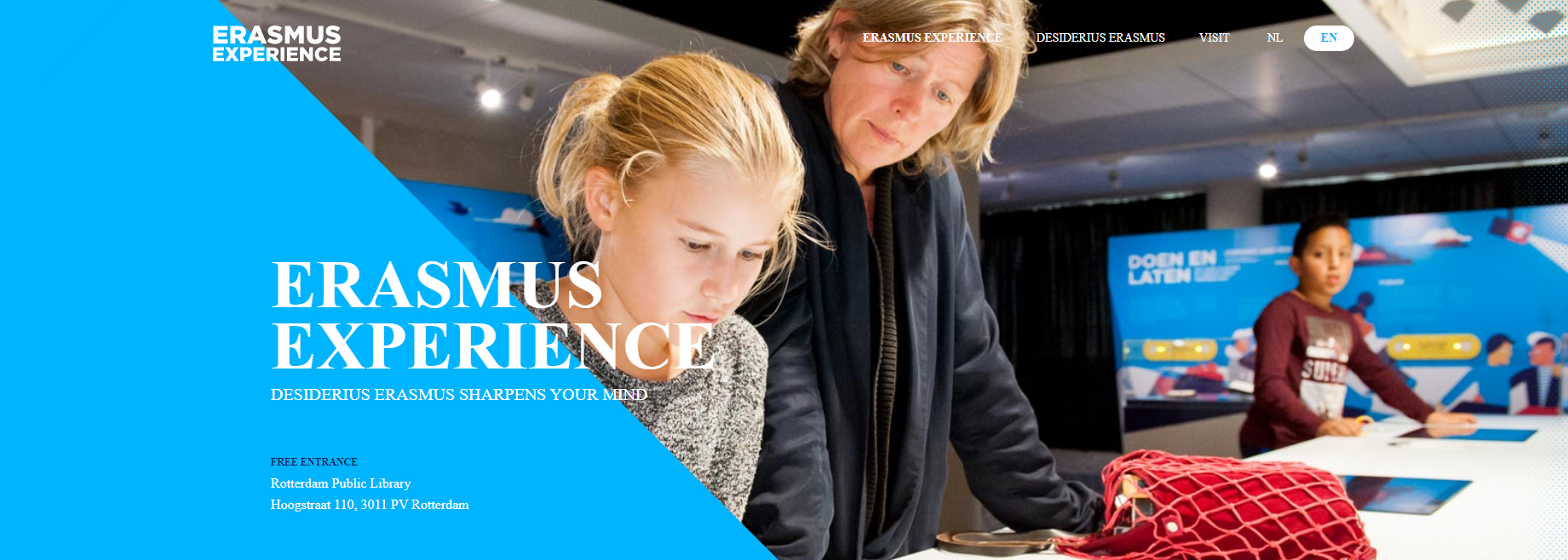
The Rotterdam Central Library boasts the largest Erasmus collection in the world. It is just behind “The Erasmus Experience” which is where I am going to meet the great man. I am told he has a wonderful sense of humour, enjoys irony and is quick to point out the absurd in human thoughts and actions. I need to sharpen my wits.
There are several panels in Dutch and English before me building a large circular arena. Each panel references a subject important to Erasmus and he wants to talk about them all with me.
Time to Talk
I put on a wristband with which I can answer his questions. By the end of the meeting, I will know if we agree about things but one thing I am sure of is that, if we agree or not, Erasmus won’t mind. He believes open and free discussion to be essential to human development.
What about happiness?
“The most important condition for happiness is that you want to be what you are.”
I couldn’t agree more. I regard myself to have been very fortunate in my working life, working with interesting and talented people, and doing work that I have always felt was worthwhile.
We move onto words.
“Without language, life can’t be civilized and a human can’t be human.”
Language. One of my favourite topics. I have to say, I agree about the civilisation part.
I begin to feel I should disagree a little, show some independence of thought. After all, no-one is right all the time.
“Disagreement does no harm and can often do good.”
This is why I like you, Desiderius. I can be honest with you. We can still get on even if we don’t always see eye to eye.

I learn that Erasmus was one of the first thinkers to see marriage as an equal partnership based on mutual respect and conversing. He refers to “sweet and mutual fondness” and rejects the idea of the woman as inferior to the man. I think today’s terminology for that might be “spot on”.
He advocated religious toleration and used his insight into human folly to denounce holy war.
“I see you, while the standard of salvation is in one hand, rushing on with a sword in the other, to the murder of your brother…”
Bridging Differences
Perhaps not much has changed in the intervening five hundred years since Erasmus died in Basel. He received a splendid Catholic funeral in the heart of that staunchly Protestant city with no objection from the authorities. He was loved wherever he went although he was keen to the follies that divided humans.
Up until my visit, my acquaintance with Erasmus was largely through cataloguing his works. His most famous publication, In Praise of Folly, featured in all the collections of the universities where I had worked. It was dedicated to another great mind of the age, Thomas More, author of Utopia and a great friend of the sage from Rotterdam. They spent much time together and corresponded when separated by Erasmus’s many journeys.
I wonder if Thomas More felt like me when he first met Erasmus? I would have loved to have overheard their conversation… and I think I just have, in a way, along with so many other visitors to Rotterdam’s Central Library when they visit the Erasmus Experience.
Erasmus for Everyone
During my visit I see many young people in conversation with Erasmus though their wristband. It’s good to know that the Erasmus Experience appeals to all ages. They are looking, listening, thinking and discussing the ideas of someone as relevant today as he was in his own time, a time of huge upheaval in Europe. His legacy is safe in these young people’s minds.
And what does my wristband tell me as I end my meeting? Do Lesley Whyte and Desiderius Erasmus agree with each other?
How can we not? I have just met a man that formed the way we educate our citizens to think today.